
PVC Mechanical Properties
PVC's mechanical properties are quite different to those of HDPE:
The uniaxial stress-strain curve does not display a yield point (a point of instability). It is a "predictable" curve of decreasing slope with no discontinuities up to a break of over 300%.The multiaxial stress-strain curve displays a lower break stress than HDPE but a much higher break strain.
Much of PVC's deformation (up to the break strain) is recoverable. In HDPE strain in excess of about 12% (the yield point) is not recoverable.
PVC will conform to geometrical profiles much more readily than HDPE. HDPE has a higher puncture stress but a lower puncture strain than PVC.
Being different, each will perform better in different environments. Neither is the best under all circumstances.
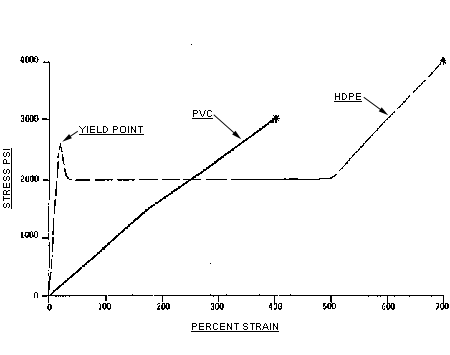
Useful strain in HDPE is 10%.
Useful strain in PVC is 300%.
HDPE yield point is a point of instability.

Figure 4.) Multiaxial Stress vs. Strain For Five Geomembrane Materials PVC has excellent ductility - ability to conform to subgrade.
PUNCTURE TESTING
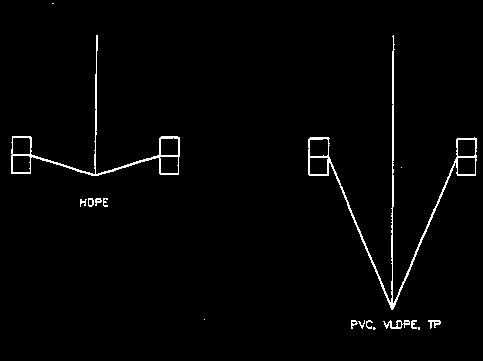
HDPE has high resistance to puncturing but with little deformation. PVC will deform significantly before puncturing.
HYDROSTATIC TESTING: PRESSURE TO FAILURE

PVC conforms to subgrade better than HDPE. HDPE has higher apparent strength but PVC conforms better and maintains an impermeable barrier.
For more information call 800-OK-LINER today!


Comments